Budgiv — an automated secondary market for businesses, built by Nuvid
Budgiv (budgiv.com) is a platform Nuvid built from the ground up: unsold machinery, equipment and stock lots are matched with verified business buyers, bids are collected and the seller chooses. The entire flow — from discovery and matching to bids, documented realisation and reporting — is automated on serverless EU infrastructure, multilingual and in multiple currencies.
Quick overview
What it is: Budgiv is a B2B secondary market for unsold business assets. When an auction or sale doesn't reach the finish line, the platform matches the asset with verified specialist buyers, collects bids and lets the deal be made directly between seller and buyer — no deal, no fee.
What Nuvid did: built and runs the entire platform — public site, seller portal, admin tools, bid engine, "Documented realisation" with a signed report, plus the automations that monitor sources, timestamp, email and keep the data in the EU.
Impact: frees up an estimated 12 hours per week of manual work — monitoring, qualification, notifications and report compilation that would otherwise be done by hand. The figure is an estimate, see the FAQ below.
The challenge
When companies are wound down, restructured or simply replace equipment, a lot is left unsold. Machinery, equipment and stock lots that didn't reach the finish line at auction end up in a vacuum: the seller knows there is value left, but lacks the time and channels to reach the right buyer. Finding serious, verified business buyers for a specific CNC machine or a stock lot is manual detective work — phone calls, mailing lists and loose contacts.
At the same time the process itself is sensitive. It concerns business assets, sometimes from bankruptcy or reconstruction estates, where it must be possible to show how a deal was done: which bids came in, when, and why the seller chose as they did. It isn't enough to sell — it must be possible to document afterwards. That combination of matching, bid collection and traceable documentation was previously done by hand, which doesn't scale and easily becomes inconsistent.
Budgiv was to solve both parts at once: a marketplace that actively seeks out unsold assets and verified buyers, collects bids in a structured way, and produces a traceable, timestamped record of every closing.
What Nuvid built
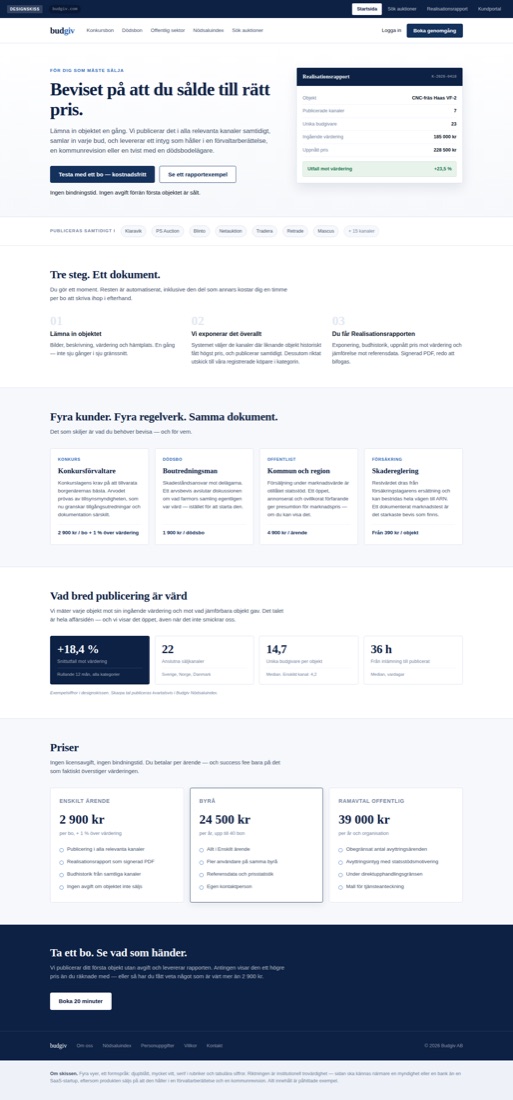
Nuvid built the whole of Budgiv as a platform of its own — not an integration on top of an existing system, but the product itself, from public site to operation. At its core is the matching: an unsold asset is listed as a sale item, matched with verified specialist buyers, and the buyers place bids in a structured bid room. The seller sees the bids and chooses which is accepted. The deal is then made directly between seller and buyer — Budgiv only charges when a deal goes through.
Around the matching, Nuvid built the parts that make it credible and workable:
- Seller portal where a seller (or an estate administrator, liquidator or audit firm representing several clients) lists assets, chooses channels, publishes and follows the bids.
- Verified buyers — the buyer side is qualified, so that bids come from real companies and not from just anyone.
- "Documented realisation" and the Realisation Report — every closing can be generated as a signed, timestamped PDF that shows how the deal was done. The report's values are always taken from a frozen report row, never from the live record, so that the same report can be recreated identically afterwards.
- Admin tools for the entire operation: cases, sources, prospects, outreach, campaigns, contacts and incidents.
- Public site with audience pages for bankruptcy, reconstruction, liquidation, audit firm and proof — multilingual and in multiple currencies (SEK and beyond).
See how Nuvid works with this kind of platform under our solutions.
How it's built — APIs, automations and infrastructure
Budgiv runs entirely on serverless edge infrastructure, with the data located in the EU. The foundation is a serverless hosting platform for the public site and portal, with serverless APIs (endpoints under /api/…) for ordering, application, authentication, account, portal and admin. Beneath them sit:
- A serverless SQL database — provisioned with EU jurisdiction so that data stays in Europe, with migrations and unique indexes that protect invariants (e.g. that a sale item can only have one valid report).
- Object storage in the EU for uploaded documentation, with a key-value-based deletion ledger so that deletions of sensitive files can be proven.
- Server-side rendering in the browser that drives the PDF generation of the Realisation Report.
- A separate scheduler service — distinct from the hosting project — that pings
/api/cron/*every day with a Bearer secret and runs the scheduled jobs.
The automations (cron jobs) are where much of the manual work disappears. Among them: public-notice monitoring that each morning discovers, enriches and emails the day's sale list; a chain head that creates and qualifiedly timestamps the day's reports, with an absence alert that triggers if no timestamping has happened in 48 hours; a "word guard" that fetches the published legal pages and alerts if the copy has drifted from what was approved; deletion jobs that clean up uploaded documentation according to policy, with a guard of their own that alerts if anything that should have been deleted is still there; plus notification jobs that send neutral notice emails (only a case number and "log in", never details). In addition there are jobs for outreach, portal incident digests, market entry and final-price collection.
On the security and privacy side: a bot protection guards the public forms against bots, Resend handles email from a dedicated sender domain, and the signing is built on bespoke Ed25519 keys with public verification keys and verification pages so that a report can be checked from the outside. Nuvid also handled the design (bespoke brand book and components), SEO/GEO (audience pages, sitemap and a publishing runbook) and third-party connections (Stripe for payment when a deal goes through, Resend for email, a bot protection for gating). SEO/GEO isn't a side matter here but part of the business model: demand and traffic are meant to come organically via search and AI answers — not via paid advertising — so the tool builds its own inbound channel without a media budget.
How much time it frees up
The point of the automation isn't that it's sophisticated, but that it removes recurring manual work. Below are the manual tasks that existed before, how they were solved, and an estimate of the time freed up per week. The time figures are estimates, not measured KPIs.
| Manual task | How we solved it | Time freed up |
|---|---|---|
| Seeking out the day's unsold assets and public notices by hand | Public-notice monitoring that each morning discovers, enriches and emails the day's list | ~4 hrs/week |
| Qualifying and notifying buyers/sellers manually via email | Verified buyer side + neutral, idempotent notification jobs | ~3 hrs/week |
| Compiling and timestamping documentation on every closing | Chain head that timestamps automatically + Realisation Report as PDF | ~3 hrs/week |
| Cleaning up uploaded files and monitoring copy/legal pages | Deletion jobs with a guard + "word guard" that alerts on drift | ~2 hrs/week |
Summed up, it lands in the order of 12 hours per week that no longer goes into monitoring, qualification, notifications and report compilation. But the time freed up isn't the whole point. The real value is the business value: more unsold assets actually reach the right buyer, more bids come in and more closings happen — value that would otherwise have stayed unsold. The automation means matching and bid collection happen at scale, not as time allows.
Results and next steps
Budgiv is built and in operation on budgiv.com, with the entire chain in place: public site, seller portal, bid engine, Documented realisation, admin tools and the scheduled jobs that keep the flow going. The platform is multilingual and handles multiple currencies, with the data located in the EU and a clear stance on privacy — neutral notifications, provable deletion and verifiable reports. The core value is that more closings can happen and that the inflow of sellers and buyers is built to grow organically via SEO/GEO, without an ad budget.
The next step for a platform like this is usually to broaden the buyer side and roll out more markets and languages, plus switching on the automations that are gated until the right conditions are in place (e.g. outreach sending behind a daily quota). The foundation is built so this can be done step by step, without touching the core.
Want to build something similar — a bespoke platform, marketplace or an automated flow with traceability — get in touch and we'll look at it together.
See more examples under our solutions, explore more cases and platforms we've built, or get three free suggestions.