DonsöHouse — floating homes with a quote and customer flow that runs itself
DonsöHouse builds Scandinavian houseboats and floating homes for year-round living — DONSÖ 20, 30 and 50 m². Nuvid built the entire multilingual website and automated quote requests, kit orders and the reseller flow, so that every enquiry is captured, saved and confirmed without manual work.
Quick overview
In short: DonsöHouse sells floating homes in three sizes across five languages. Nuvid built the website and automated the whole path from visitor to qualified request — quotes, kits and reseller applications land in a structured way in a database, the team gets a notification, and the customer receives a confirmation email straight away.
How we built it:
- A multilingual website (SV/NO/DA/FI/EN) on serverless hosting, with model, guide and partner pages.
- A quote and order flow: the forms send to dedicated API functions that validate, save to a database and email both the team and the customer automatically.
- An internal admin mode for reseller and partner contacts, with status and priority in a simple pipeline.
Impact: frees up an estimated 14 hours a week by removing manual entry, copying of requests and parallel publishing in several languages.
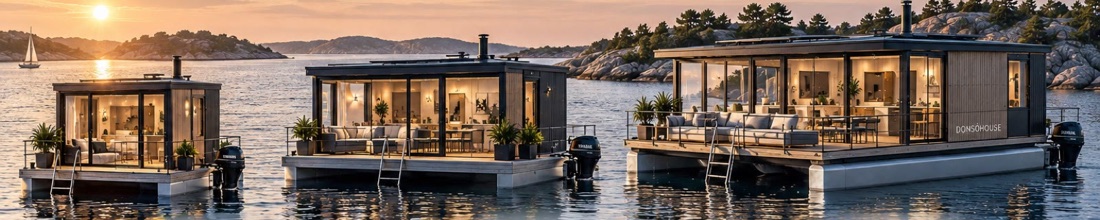
The challenge
DonsöHouse sells a well-considered product — floating homes and houseboats for year-round living, in three sizes and with options such as a roof terrace and a winter package. But a product like this puts demands on the information around it: the buyer wants to compare models, understand the rules on building permits and mooring, see what it costs and then be able to get in touch easily. And the buyers are in several countries, which means several languages.
Without automation it becomes heavy going. Every quote request has to be read, entered somewhere, answered and followed up. Resellers and partners who get in touch easily end up in the same inbox as everything else. Content that needs to exist in Swedish, Norwegian, Danish, Finnish and English has to be published and kept in sync. This is exactly the kind of repetitive work that steals time every week and where things fall between the cracks when someone is off sick or busy.
In short: the product was strong, but the flow from visitor to handled request needed to be built so that it scales without the team drowning in administration.
What Nuvid built
Nuvid built DonsöHouse's entire web presence and the automations behind it. This is not a brochure site but a platform where every expression of interest is captured and taken forward automatically.
- Multilingual website. Home page, model pages for DONSÖ 20/30/50, gallery, sustainability, FAQ and an extensive guide section on living on the water — published in five languages with correct language markup so that the right version is shown to the right visitor.
- Automated quote flow. The "Request a quote" form sends the request to a dedicated API function that validates the content, saves it in a structured way in a database, emails the team a notification and sends the customer a confirmation email in the right language — all within seconds.
- Kit orders. For customers who want to build themselves, a separate flow takes component orders, adds up the subtotal and a shipping estimate, and emails a complete basis to the team.
- Reseller and partner flow. The partner page has its own application form that enters the same structured flow, tagged as a reseller, so that no business opportunities get mixed up with ordinary customer enquiries.
- Internal admin mode. A logged-in mode gathers reseller and partner contacts in a simple pipeline with status and priority, so the team can see who to contact next.
- Built-in bot and spam protection. The forms are protected with both an invisible honeypot and verification, so that the team avoids junk requests and only genuine leads reach the inbox.
The point is that DonsöHouse never needs to copy a request by hand. What the visitor fills in already lands structured, confirmed and ready to follow up. If you'd like to see more examples of how we build this kind of flow, they're under our solutions.
How much time it frees up
Our estimate is that this setup frees up in the order of 14 hours a week for DonsöHouse. It is an estimate, not a measured figure — but it is based on concrete steps that would otherwise be handled manually. Three things weigh heaviest.
Quote requests. Every request that would otherwise be read, entered into a system, acknowledged to the customer and queued for follow-up is now handled automatically. The more requests, the more time is saved — and the customer gets a reply straight away, even outside office hours.
Multilingual publishing. Keeping the same content live in five languages is a lot of manual work. With a well-considered structure for the language versions, the team avoids copying and pasting between pages and keeping track of which version is the latest.
Reseller and partner handling. Applications that are captured in a structured way and gathered in an admin mode mean no one has to build their own list in a spreadsheet or dig through the inbox for who was to be contacted. The status is already in place.
Think of it as a whole working day a week being moved from administration to sales and customer contact. Below is how the steps break down.
| Manual step | How we solved it | Time freed up |
|---|---|---|
| Reading and entering quote requests by hand | Form → validation → database, with a team notification automatically | ~5 hrs/week |
| Answering and confirming to the customer manually | An auto-confirmation in the right language is sent straight away | ~2 hrs/week |
| Publishing and syncing content in five languages | Structured language versions with correct markup | ~4 hrs/week |
| Keeping track of resellers and partners | A dedicated application flow + admin pipeline with status | ~2 hrs/week |
| Filtering out spam and bot requests | Honeypot + verification on all forms | ~1 hr/week |
The figures are illustrative and scale with the volume of requests — but the direction is clear: the recurring administration is removed, not just shortened.
The technology behind it
DonsöHouse runs entirely on bespoke, serverless edge infrastructure, which gives fast delivery close to the visitor and means the heavy work happens on the server where it belongs — not in the visitor's browser.
- Serverless hosting hosts the website itself, with the static pages published and versioned.
- Serverless functions drive the logic behind the forms. Every form sends to a dedicated API function that validates, limits field lengths and rejects invalid input before anything is saved.
- A bespoke database stores quote requests and outreach contacts in a structured way, so that nothing lives only in an inbox.
- Transactional emails are sent via an email service: a notification to the team and a confirmation to the customer, with separate texts for Swedish and English/other languages respectively.
- Bot protection is built in two layers — an invisible honeypot plus verification — so that the forms withstand junk traffic without getting in the way of genuine visitors.
Everything described here is part of the solution. The setup is deliberately easy to keep running: no heavy systems to maintain, just simple, self-contained functions that each do one thing.
Results and next steps
The result is a website that not only presents DonsöHouse's products but also works. Visitors in five countries are met in their own language, find the right model and guide, and can send a request that is immediately captured, saved and confirmed. The team spends its time selling and building relationships instead of entering and sorting.
The next step for this kind of flow is usually to connect onward what is already being collected — for example syncing structured leads to a CRM or accounting system, or adding more languages and campaign-specific pages. The foundation is built so that it can grow step by step without a rebuild.
If you have a similar need — a product that deserves a website that actually takes care of the requests — get in touch and we'll look at your flow together.
Want to see how this looks in practice? Explore our solutions, see more cases and platforms we've built, or get three free suggestions.
How it's built — APIs, automations and infrastructure
For anyone who wants to understand the machinery behind the page — here is how DonsöHouse is built, step by step:
- APIs. The forms go to dedicated server functions:
functions/api/intresse.jsreceives quote and partner requests, validates the fields and saves them in a structured way;functions/api/order.jsreceives kit orders of components. - Automations. Every request triggers two emails automatically — a notification to the team and a confirmation to the customer in the right language (separate texts for Swedish and English/other languages respectively). The kit flow also adds up the subtotal, shipping estimate and instalment payment (50% on order, 50% on delivery) in the order basis.
- Infrastructure. Everything runs on bespoke, serverless hosting with the server logic in serverless functions, and quote requests as well as outreach contacts are stored in a bespoke database. No server of your own to run.
- Bot protection. The forms have two layers: an invisible honeypot that catches bots silently, plus a bot protection that kicks in when the key is set — so that only genuine leads reach the inbox.
- Design. A multilingual website with a home page, model pages for DONSÖ 20/30/50, gallery, sustainability and a partner page — built to compare models and move on to a request.
- SEO/GEO. Content in five languages in dedicated directories (SV/NO/DA/FI/EN) with hreflang markup, an extensive guide library on living on the water and structured data (schema) on key pages.
- Third-party integrations. The transactional emails are sent via Resend, and a logged-in admin mode (
functions/admin/api/outreach.js) gathers reseller and partner contacts in a simple CRM pipeline with status.